Global buyers entering 2026 face a wider choice of steel wire ropes than catalog names suggest. Haggie Steel Wire Rope remains relevant where lifting safety, fatigue resistance, and traceable manufacturing matter. Its selection requires more than comparing breaking loads. Buyers must examine rope construction, steel grade, core design, lubrication, lay direction, and compliance documentation.
Market data supports this careful approach. Grand View Research identifies construction, mining, oil and gas, and marine operations as major wire rope demand sectors. Its published studies also indicate steady global market growth through the decade. MarketsandMarkets reports similar expansion, driven by infrastructure investment, port modernization, and heavy industrial handling. However, these reports use different market definitions. Their forecasts should guide planning, not replace technical verification.
Details matter. A compacted strand rope may improve drum spooling and abrasion performance. A rotation-resistant rope can support demanding crane applications but needs disciplined installation. Galvanized rope offers stronger corrosion protection for marine and outdoor environments. Stainless steel may suit specialized conditions, although its price can be substantially higher. Buyers should compare certificates against ISO 2408 and applicable EN 12385 requirements. They should also request factory inspection records, batch identification, and proof-load documentation.
Not every rope fits.
This guide reviews leading Haggie Steel Wire Rope types for 2026 purchasing decisions. It connects published industry evidence with practical checks used in lifting-equipment procurement. Still, product suitability depends on the complete system, including sheaves, drums, load cycles, and operating climate. A mistake remains possible when buyers rely only on headline strength. Careful engineering review is the safer standard.
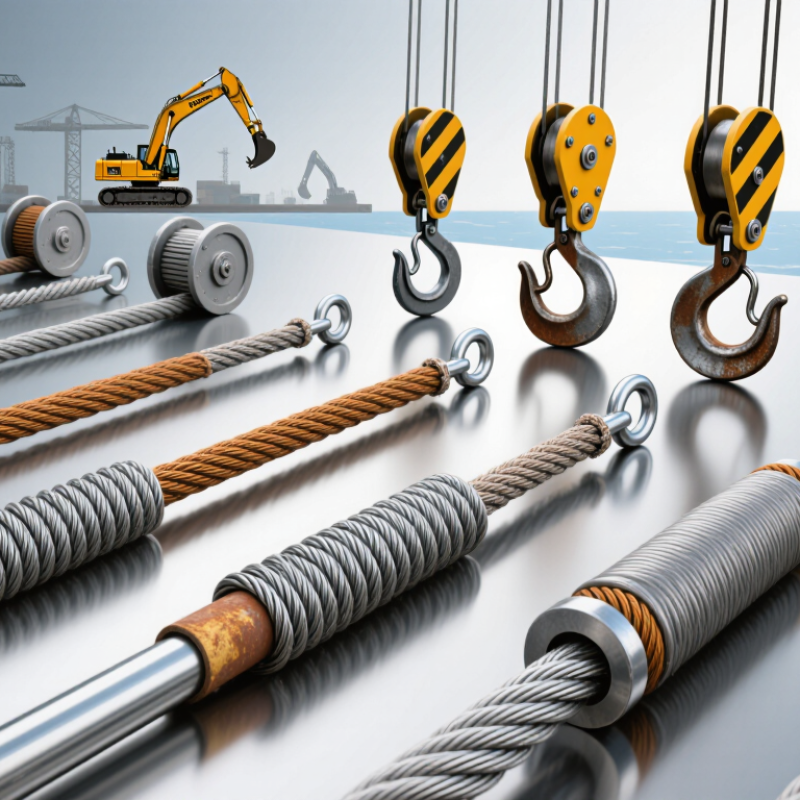
For global buyers, wire rope selection starts with construction, not price. The 6×19 rope has six strands around a core, with relatively larger outer wires. It offers good abrasion resistance and works well on general lifting equipment. The 6×37 design uses finer wires and more wires per strand. It bends more easily around sheaves, but its smaller wires can wear faster in harsh contact conditions.
The core changes rope behavior. A fiber core is lighter and more flexible, while an independent wire rope core improves crush resistance and temperature performance. Choose regular lay when handling stability matters. Lang lay can provide better fatigue resistance, but it demands careful installation and controlled winding. Small details matter, especially fleet angle, drum grooves, and sheave diameter.
Tensile grades commonly range from 1,570 to 2,160 MPa. Higher strength can increase lifting capacity, yet it does not automatically deliver longer service life. Higher-grade wire may need compatible sockets, drums, and inspection procedures. During inspections, look for broken wires, birdcaging, corrosion, and diameter loss. A frequent mistake is choosing by nominal strength alone. I would also question supplier charts that omit lay direction, core type, or test certification. That missing information can change the real selection.
| Rope Type / Parameter | Construction or Grade | Typical Characteristics | Flexibility | Abrasion Resistance | Common Applications | Buyer Selection Notes |
|---|---|---|---|---|---|---|
| 6×19 Classification | Six strands around a center; commonly supplied with 19 wires per strand | Balanced general-purpose construction with relatively larger outer wires | Medium | Good | Cranes, hoists, winches, derricks, general lifting and material handling | A practical choice where abrasion resistance and economical service are more important than maximum flexibility |
| 6×37 Classification | Six strands around a center; commonly supplied with 37 wires per strand | More wires and smaller individual wires than 6×19 constructions | High | Moderate to good | Multi-layer winding, reeving systems, elevators, cranes and applications with repeated bending | Use when flexibility and resistance to repeated bending are priorities; protect against severe crushing and abrasion |
| Fiber Core (FC) | Natural or synthetic fiber center | Lightweight and flexible; provides internal lubricant retention | High | Lower resistance to crushing and heat than steel cores | General lifting, low-to-moderate temperature hoisting and flexible reeving | Confirm temperature limits, drum pressure and fleet angle before choosing FC |
| Independent Wire Rope Core (IWRC) | A separate steel wire rope forms the core | Higher strength, dimensional stability and resistance to drum crushing than FC | Medium to high, depending on construction | Very good | Heavy-duty cranes, winches, offshore handling, mining and multi-layer spooling | Often preferred for high loads, high drum pressure, elevated temperatures and demanding operating cycles |
| Independent Wire Strand Core (IWS) | A separate steel strand forms the core | Steel-supported core with properties between a fiber core and a full IWRC, depending on design | Medium | Good | Selected hoisting and winching systems requiring additional core support | Check the manufacturer’s specified minimum breaking force and core designation because dimensions vary by design |
| Regular Lay | Wire direction is opposite to strand direction | Generally easier to handle and less likely to untwist during normal installation | Good | Good | General lifting, cranes, hoists, winches and standard reeving arrangements | Usually the default selection unless a specific equipment design requires lang lay |
| Lang Lay | Wire direction is the same as strand direction | Greater contact length between wires and sheaves; can provide improved wear performance in suitable systems | High | Often very good against bending wear | Specialized hoisting, dragline, mining and applications with controlled end termination | Requires careful installation and termination because it has a greater tendency to rotate or unlay if misused |
| Grade 1570 | Nominal tensile strength: 1,570 MPa | Lower strength grade with established use in general-purpose wire rope | Depends on construction | Depends on construction and wire finish | Standard lifting, support and pulling applications where design loads permit | Do not compare grade alone; verify minimum breaking force for the exact diameter, construction and core |
| Grade 1770 | Nominal tensile strength: 1,770 MPa | Common medium-high strength grade for many industrial ropes | Depends on construction | Depends on construction and wire finish | Cranes, hoists, winches, elevators and general industrial equipment | A widely specified grade when a balance of strength, availability and operating performance is required |
| Grade 1960 | Nominal tensile strength: 1,960 MPa | Higher strength grade that can increase line pull or reduce rope diameter when permitted by the equipment | Depends on construction | Depends on construction and surface treatment | Heavy lifting, mobile cranes, offshore equipment and high-load winching | Confirm compatibility with sheaves, drums, terminations, design factor and applicable regulations |
| Grade 2160 | Nominal tensile strength: 2,160 MPa | Very high strength grade for designs requiring high minimum breaking force | Depends on construction | Depends on construction, finish and operating conditions | Specialized heavy lifting, high-capacity cranes and selected high-performance hoisting systems | Higher tensile grade does not automatically mean longer service life; system design and fatigue conditions remain critical |
A 6×19 rope uses larger outer wires and resists abrasion well. A 6×37 rope bends more easily around sheaves.
A fiber core provides lower weight and greater flexibility. It may suit applications requiring frequent bending.
It improves crush resistance and temperature performance. This can help on drums exposed to heavy pressure or heat.
Regular lay offers better handling stability. Lang lay can improve fatigue resistance but requires careful installation and winding control.
No. Grades from 1,570 to 2,160 MPa can increase lifting capacity, but service life depends on operating conditions.
Their strands are pressed tightly during production. Depending on construction and diameter, breaking force may increase by 15%–20%.
Check grade, diameter, lay direction, minimum sheave ratio, drum compatibility, and socket compatibility.
Inspect for broken wires, birdcaging, corrosion, crushed sections, diameter loss, and uneven wear.
Their smooth surfaces may hide early wire breaks. Set inspection intervals before delivery, not after the first failure.
Sheave alignment, drum grooves, fleet angle, lubrication, and bending frequency can strongly affect service life.
Haggie Steel Wire Rope selection in 2026 depends on matching construction, core design, lay direction, strength grade, and operating conditions. Common 6×19 and 6×36 ropes offer a practical balance of flexibility, abrasion resistance, and durability, while grades from 1,570 to 2,160 MPa provide options for different load requirements. Fiber cores can improve flexibility, whereas independent wire rope cores generally deliver greater crush resistance and dimensional stability.
For cranes, hoists, and lifting systems, rotation-resistant 19×7 ropes help control torque through multiple strand layers, typically using 18 to 24 strands. Compacted ropes can provide approximately 15%–20% higher breaking force and improved contact performance over sheaves. Buyers should evaluate working load, bending cycles, corrosion exposure, and safety factors while aligning specifications with ISO 2408 and EN 12385. These principles support safer and more efficient applications across construction, ports, mining, logistics, and industrial lifting operations.

 Hanshen