Choosing High Carbon Steel Wire in 2026 requires more than comparing tensile strength and price. The correct grade must match the product’s load, forming process, surface condition, and service environment. A spring wire may need high elastic recovery. A tire bead wire may require strict diameter control and strong fatigue resistance. These differences become visible on the factory floor, where inconsistent coils can cause die wear, surface cracks, or sudden line stoppages.
Global steel output provides useful context. The World Steel Association’s World Steel in Figures 2024 reports approximately 1.892 billion tonnes of crude steel production in 2023. This scale shows why supply-chain quality can vary between regions and mills. The association’s Short Range Outlook also indicates continued pressure on steel producers to improve efficiency and manage uncertain demand. However, broad steel reports do not replace wire-specific testing. That limitation matters.
Buyers should review carbon content, tensile strength, reduction of area, decarburization depth, and coil traceability. ISO 16120 supports requirements for non-alloy steel wire rod, while ASTM A510/A510M addresses general wire and wire rod specifications. These standards offer a reliable starting point, not a complete purchasing decision. A certificate alone may look convincing. It can still miss handling damage or inconsistent drawing performance.
The practical question is simple: will the wire perform after forming, coating, welding, or repeated loading? Request mill certificates, sample coils, test results, and production references. Do not select the cheapest option automatically. That shortcut can become expensive. A stronger process combines recognized standards, supplier audits, independent verification, and honest review of previous failures.
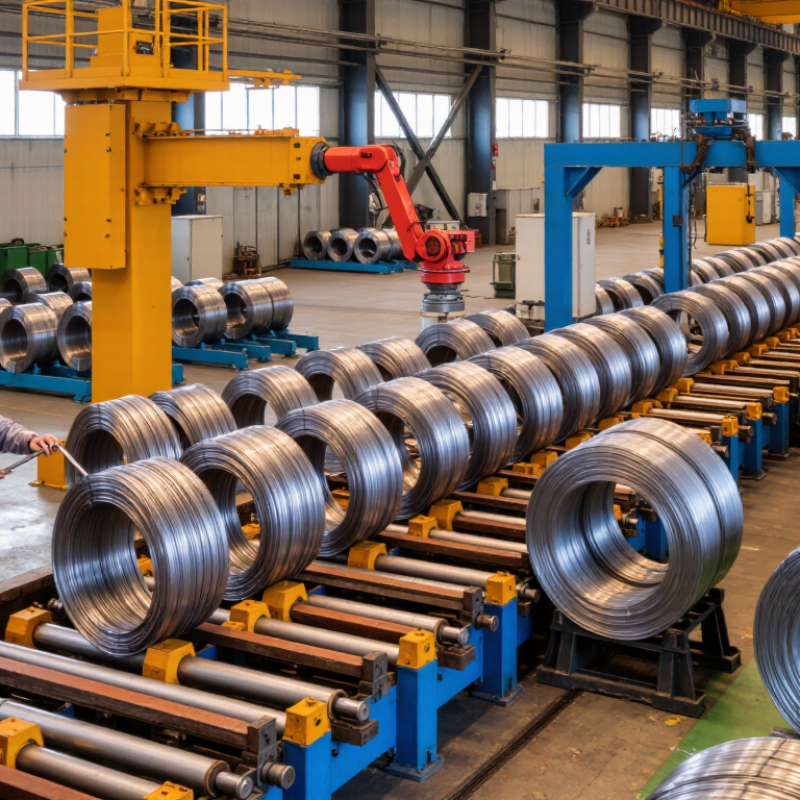
Before comparing grades, define what the wire must do in its finished product. Start with the job. A spring that cycles thousands of times needs fatigue resistance and consistent dimensions, while mesh may prioritize formability and uniform coating. For cold-formed parts, note bend radius and forming sequence; high strength alone can increase cracking risk. Record the required wire diameter, tensile range, surface condition, and operating temperature. Details matter.
Translate those needs into measurable acceptance criteria, such as allowable diameter variation, minimum tensile strength, or performance after repeated loading. The first specification is often incomplete; that is normal, but leaving it vague invites costly trials. A common shop-floor mistake is choosing the strongest available wire before checking whether it can be drawn, bent, or joined reliably. Ask the supplier for a material certificate and confirm which test method supports each value. When the application is unusual, trial a small production-representative batch and inspect the finished part, not just the incoming coil. A clean sample can still behave differently at full production speed. Keep room for adjustment, because the best balance of strength, ductility, and process stability is not always obvious on paper.
| Application | Typical Carbon Content | Performance Requirements to Define | Useful Selection Checks | Important Trade-Off |
|---|---|---|---|---|
| Mechanical springs | Commonly about 0.60–1.00% carbon, depending on wire type and specification | Elastic limit, tensile strength, fatigue resistance, diameter tolerance, and consistency after forming | Specify spring design, wire diameter, coiling process, heat treatment, operating stress, and required fatigue life. | Higher strength can support compact designs, but may reduce formability and increase sensitivity to surface defects. |
| Prestressed concrete strand or wire | Often about 0.70–0.85% carbon | Specified tensile strength, ductility, relaxation behavior, bond or surface requirements, and dimensional consistency | Identify the applicable construction standard, product form, strand configuration, test method, and required relaxation class. | Strength and relaxation requirements must be balanced with reliable drawing, stranding, and performance in the finished concrete product. |
| Tire bead wire | Often about 0.70–0.90% carbon | Tensile strength, adhesion to the coating or rubber system, fatigue resistance, and clean surface condition | Confirm coating type, adhesion process, wire diameter, drawing condition, and the tire maker’s test requirements. | Surface cleanliness and coating compatibility matter alongside strength; excessive surface damage can impair performance. |
| Wire rope and strand | Commonly about 0.60–0.85% carbon, depending on wire grade and construction | Breaking force, bending fatigue, abrasion resistance, ductility, and corrosion protection needs | Define rope construction, wire diameter, duty cycle, sheave size, environment, and lubrication or coating requirements. | Greater strength does not by itself ensure longer service life; bending, abrasion, corrosion, and maintenance are also important. |
| Fine cutting or saw wire | Often about 0.80–0.95% carbon for high-strength fine wire | High tensile strength, straightness, diameter uniformity, surface quality, and resistance to breakage during use | Specify final diameter, drawing route, surface finish, allowable defects, and the process conditions in which the wire will operate. | Fine, highly drawn wire can be strong but may be less tolerant of nicks, handling damage, and abrupt loading. |
| General-purpose hard-drawn wire | Typically selected within roughly 0.60–0.90% carbon for many high-carbon wire uses | Required tensile range, dimensional tolerance, bend performance, and surface condition | State whether the wire will be formed, straightened, coated, or used as drawn, and select the applicable product specification. | Do not select by carbon content alone: drawing reduction, diameter, heat treatment, and surface condition affect final properties. |
| Selection note: Carbon ranges are indicative examples, not universal grade limits. Tensile strength and other properties depend on product specification, wire diameter, processing, and test method. Confirm requirements against the applicable standard and the actual end-use conditions before ordering. | ||||
Match the grade to the working duty, not carbon content alone. Grade 1070 offers balanced strength and formability. Grade 1080 provides higher hardness after proper heat treatment. Grade 1095 can reach excellent hardness but bends less easily. The hardest option is not always best.
Diameter changes stiffness, strength response, and forming behavior. A 1.0 mm wire reacts differently from a 4.0 mm wire. Check tensile strength, yield strength, hardness, elongation, and tolerance together. Small details matter.
Review fatigue data, torsional performance, surface condition, and diameter consistency. Repeated loading can reveal weaknesses hidden by a single tensile test. Test a short coil under realistic loading. Laboratory results may still miss production problems.
Annealed wire usually suits later forming and bending. Patented or oil-tempered wire may support direct spring production. Confirm the condition before ordering. The wrong condition can increase cracking and forming effort.
Inspect seams, rust spots, drawing lines, and uneven lubricant residue. Use strong side lighting. Scratches can concentrate stress during repeated bending. A shiny surface proves little, honestly.
Compare coating mass, adhesion, thickness, and test method. Zinc can improve atmospheric resistance. Phosphate or polymer layers may assist drawing and handling. Choose protection for the actual environment, not a vague corrosion claim.
Request the mill certificate, heat number, dimensional tolerance, and coating test record. Verify samples with hardness and diameter measurements. Check ovality, decarburization limits, coil weight, and inspection frequency. Paperwork helps, but it is not absolute proof.
Humidity and handling can expose weaknesses after initial inspection. Repeat bend testing after storage when possible. I might overlook this step myself. A fresh sample can appear perfect, then fail during coiling. That mistake is common.
Choosing High Carbon Steel Wire in 2026 begins with clearly defining the application, operating environment, load requirements, and expected service life. Buyers should compare steel grades, wire diameters, tensile strength, hardness, and other specifications to ensure the material matches the intended use. Important performance factors include strength, ductility, surface finish, dimensional consistency, and the availability of suitable coatings for corrosion protection or improved handling.
Before making a decision, review the manufacturer’s production standards, inspection procedures, and quality test results, including tensile, bending, fatigue, and surface evaluations where applicable. Supplier selection should also consider technical support, delivery reliability, traceability, and the wire’s compatibility with drawing, forming, welding, or heat-treatment processes. A well-qualified supplier should be able to provide clear documentation and help confirm that the selected wire can perform consistently throughout manufacturing and service.

 Hanshen