High-Strength Steel Wire supports bridges, suspension systems, tire reinforcement, springs, and demanding industrial equipment. Its value comes from controlled chemistry, tensile strength, fatigue resistance, and consistent surface quality. A small defect can matter greatly when wire carries repeated loads inside a bridge cable or vehicle tire. The stakes are high.
Global demand remains connected to construction, automotive production, energy infrastructure, and advanced manufacturing. The World Steel Association reported approximately 1.88 billion tonnes of crude steel production worldwide in 2024. This figure shows the scale of the supply base, but it does not measure specialty wire capacity directly. Grand View Research identifies construction, automotive, and industrial uses as major steel wire market segments. Its findings also point toward continuing demand for stronger, lighter, and more durable materials.
This guide examines leading High-Strength Steel Wire manufacturers across major production regions. It considers product grades, drawing technology, heat treatment, coating options, certifications, delivery capability, and application experience. Relevant benchmarks include ASTM, EN, ISO, and customer-specific specifications. Manufacturing claims should be checked against mill certificates, tensile-test results, fatigue data, and audit records. Public rankings can be useful, but none is permanently complete. Company capacity figures may differ by reporting year, product scope, or facility definition. That limitation deserves attention. Reliable selection requires more than impressive machinery photographs or a polished website. It requires evidence from operating plants, technical documentation, and verified customer applications. The following overview therefore focuses on measurable capability, regional reach, and practical suitability rather than popularity alone.
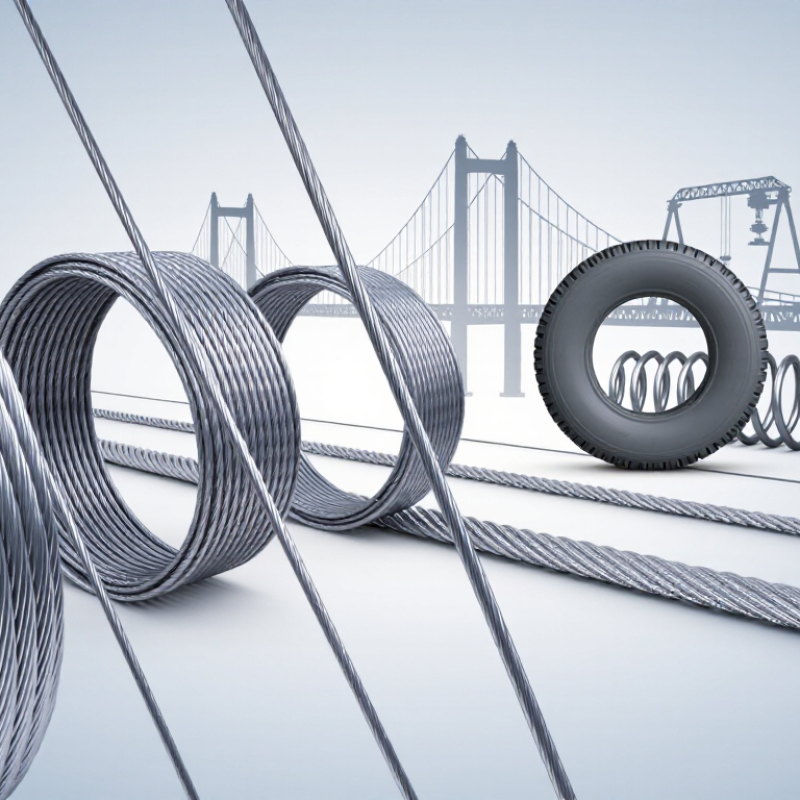
Top High Strength Steel Wire Manufacturers Worldwide
High-strength steel wire in the 1,600–2,200 MPa range supports demanding structures and engineered components. Its strength comes from controlled chemistry, heat treatment, and repeated cold drawing. A 2,000 MPa wire may look ordinary. Its performance is not.
Manufacturers must control diameter, surface quality, residual stress, and tensile consistency across every coil. Small surface cracks can become serious failures under repeated loading. Reliable production includes tensile tests, bend tests, torsion checks, and microscopic inspection. Traceability matters too. Each coil should connect to a heat number, process record, and test report.
Higher strength does not always mean better performance. Very strong wire can lose ductility and become harder to form. Poor handling may create scratches that reduce fatigue life. Coatings can improve corrosion resistance, but they require careful adhesion and thickness control. In practical projects, engineers should examine actual elongation, relaxation behavior, and environmental exposure, not only the headline tensile value.
Some specifications appear precise, yet real service conditions remain uncertain. That deserves attention. A dependable manufacturer explains these trade-offs clearly and provides consistent data from production batches. Experience on drawing lines often reveals problems before laboratory results do. Even then, inspection should remain independent, documented, and repeatable.
| Standard or Material Family | Representative Strength Class | Typical Tensile Strength | Common Wire Diameter | Main Metallurgical Features | Typical Applications |
|---|---|---|---|---|---|
| EN 10270-1 carbon steel spring wire | SH, DH and similar high-strength spring-wire conditions | Approximately 1,600–2,200 MPa | About 0.20–6.00 mm | High-carbon steel; strength is strongly influenced by wire diameter, patented rod quality and cold drawing. | Compression springs, tension springs, torsion springs and formed spring components. |
| EN 10138-2 prestressing steel wire | Y1570, Y1670, Y1770 and Y1860 classes | 1,570–1,860 MPa nominal classes | Commonly about 5–8 mm | Cold-drawn, high-carbon prestressing steel with controlled relaxation and geometry. | Prestressed concrete beams, bridge girders, railway sleepers and structural tendons. |
| ASTM A421 prestressing steel wire | Low-relaxation and stress-relieved wire grades | Common minimum levels around 1,725–1,860 MPa | Typically about 4–8 mm | High-carbon prestressing wire manufactured with controlled drawing and stress-relief treatment. | Prestressed and post-tensioned concrete construction. |
| ASTM A416 prestressing steel strand | Grade 250, nominal 1,860 MPa strand | Approximately 1,860 MPa | Common strand sizes: 9.5, 12.7 and 15.2 mm | Seven-wire strand construction; designed for high strength, anchorage performance and controlled relaxation. | Bridges, parking structures, high-rise buildings, tanks and post-tensioned slabs. |
| JIS G 3502 piano wire | SWP-A and SWP-B, size-dependent grades | Approximately 1,570–2,260 MPa | Commonly about 0.08–6.00 mm | Fine high-carbon wire with high elastic limit, smooth surface and controlled dimensional accuracy. | Precision springs, musical strings, mechanical controls and high-cycle spring parts. |
| ASTM A228 music wire | High-carbon cold-drawn music-wire condition | Approximately 1,700–2,200 MPa, depending on diameter | About 0.08–6.00 mm | Very high tensile strength and elastic limit produced through fine drawing and controlled surface quality. | Small precision springs, retaining rings, instruments and demanding wire forms. |
| Patented and cold-drawn high-carbon wire | Custom strength grades for spring and mechanical wire | Typically 1,600–2,200 MPa | Approximately 0.30–5.00 mm | Strength is developed by pearlitic patenting, repeated drawing, surface conditioning and optional stress relief. | Automotive springs, industrial machinery, safety components and wire-formed parts. |
| High-strength stainless spring wire | Cold-worked austenitic or precipitation-hardening conditions | Approximately 1,600–2,200 MPa for selected conditions | Commonly about 0.10–5.00 mm | Combines high strength with corrosion resistance; exact performance depends on alloy and cold-work level. | Medical devices, chemical equipment, marine hardware and corrosion-sensitive springs. |
Technical note: Tensile-strength values are representative ranges or nominal strength classes. Actual certified values depend on the applicable standard, wire diameter, chemical composition, drawing reduction, heat treatment, surface condition and delivery condition. Product selection should be verified against the latest edition of the relevant standard and the supplier’s test certificate.
Controlled chemistry, heat treatment, and repeated cold drawing increase its tensile strength. The wire may still look ordinary. Its internal structure carries the difference.
No. Higher strength can reduce ductility and make forming more difficult. Engineers should also check elongation, relaxation, fatigue behavior, and service conditions. More strength is not automatically better.
Cold drawing reduces diameter through smaller dies and raises strength. Patenting improves drawability and ductility before further drawing. Galvanizing adds a zinc layer against moisture and corrosion.
Worn dies, poor lubrication, and excessive heat can create cracks or uneven strength. Small scratches may shorten fatigue life under repeated loading. That detail is easy to miss.
Check coating mass, thickness, adhesion, and surface cleanliness. Inspect near welds and coil ends under consistent lighting. A smooth surface does not prove internal quality.
Request tensile strength, elongation, diameter tolerance, torsion, bend performance, and relaxation data. For coated wire, request coating measurements too. One attractive report is not enough.
Each coil should connect with a heat number, process record, and test report. Traceability helps identify drawing conditions and treatment history. Without it, investigation becomes guesswork.
Match the exact grade, diameter, coating, application, and testing method to the selected standard. Different standards may use different requirements. Compliance with one does not guarantee compliance with another.
Look for calibrated equipment, repeatable inspections, documented batches, and controlled production lines. Independent verification is sensible when failure could affect public safety. I would not rely on promises alone.
High-Strength Steel Wire is engineered for demanding applications that require exceptional tensile performance, durability, and dimensional consistency. Common strength classes range from 1,600 to 2,200 MPa, with 1,860 MPa grades widely used where a balance of strength and reliability is essential. The global manufacturing landscape spans Asia, Europe, and North America, with producers serving construction, infrastructure, automotive, and industrial markets.
Modern production typically combines cold drawing, patenting, and galvanizing to achieve the required mechanical properties, surface quality, and corrosion resistance. Manufacturer comparisons should consider production capacity, coating mass, wire uniformity, and the availability of specialized strength grades. Quality assurance is generally evaluated against recognized standards, including ASTM A416, ASTM A421, EN 10270, and ISO 2408. Together, these standards help define requirements for tensile strength, chemical consistency, testing, dimensions, and performance, enabling buyers to compare suppliers more effectively and select wire suited to specific engineering conditions.

 Hanshen